Introducing CustomerLake Conversions: Improve advertising performance with first-party customer context
Show advertising platforms which conversions are the most valuable, then bring campaign results back to your customer data and AI foundation, with full control over what you share.
by Tasso Argyros, Katy Yuan and Cindy Jiang
- CustomerLake Conversions is a new capability of CustomerLake Campaign Agents, the Agentic CDP built natively in Databricks. It connects first-party customer data and ML models to advertising activation and measurement.
- Marketers define value-based conversion signals, such as a first purchase from a customer with high predicted lifetime value, then send those signals and audiences to ad platforms through Conversions API (CAPI) integrations. Campaign performance insights return to Databricks via OpenSharing and Lakeflow Connect.
- Brands and agencies work from one governed foundation in Unity Catalog, with delegated permissions and an audit trail of what was sent where. Launch partners include Amazon Ads, Google, LinkedIn, Meta, Microsoft Ads, Reddit, Snapchat, The Trade Desk, Tiktok, Epsilon, Merkle, and Omnicom.
Two purchases can look identical in campaign reports and mean very different things to your business. One buyer has potential to become a loyal regular; the other is a first-time purchase driven by a deep discount. Both count as conversions, but their long-term value can be very different.
Your business has data that helps identify the difference: purchase history, margin, loyalty, engagement, and predicted lifetime value. Bringing that understanding into advertising can change the customers you pursue, the signals you send, and how you evaluate success.
Today, we’re introducing CustomerLake Conversions: a new capability within Databricks’ Agentic CDP that connects first-party data and context directly to advertising activation and measurement. It helps brands pursue more valuable conversions and improve return on ad spend (ROAS), while controlling the data they share.
When available, CustomerLake Conversions will be accessible to all customers using Campaign Agents in CustomerLake.
We’re proud to collaborate with these advertising and agency partners for this launch:

One workflow for advertising performance, built on customer context
CustomerLake is the Agentic CDP built natively in Databricks, the enterprise data and AI platform where your most complete customer context already lives. Its Campaign Agents help marketers build audiences in natural language, activate across channels, and power 1:1 personalized experiences.
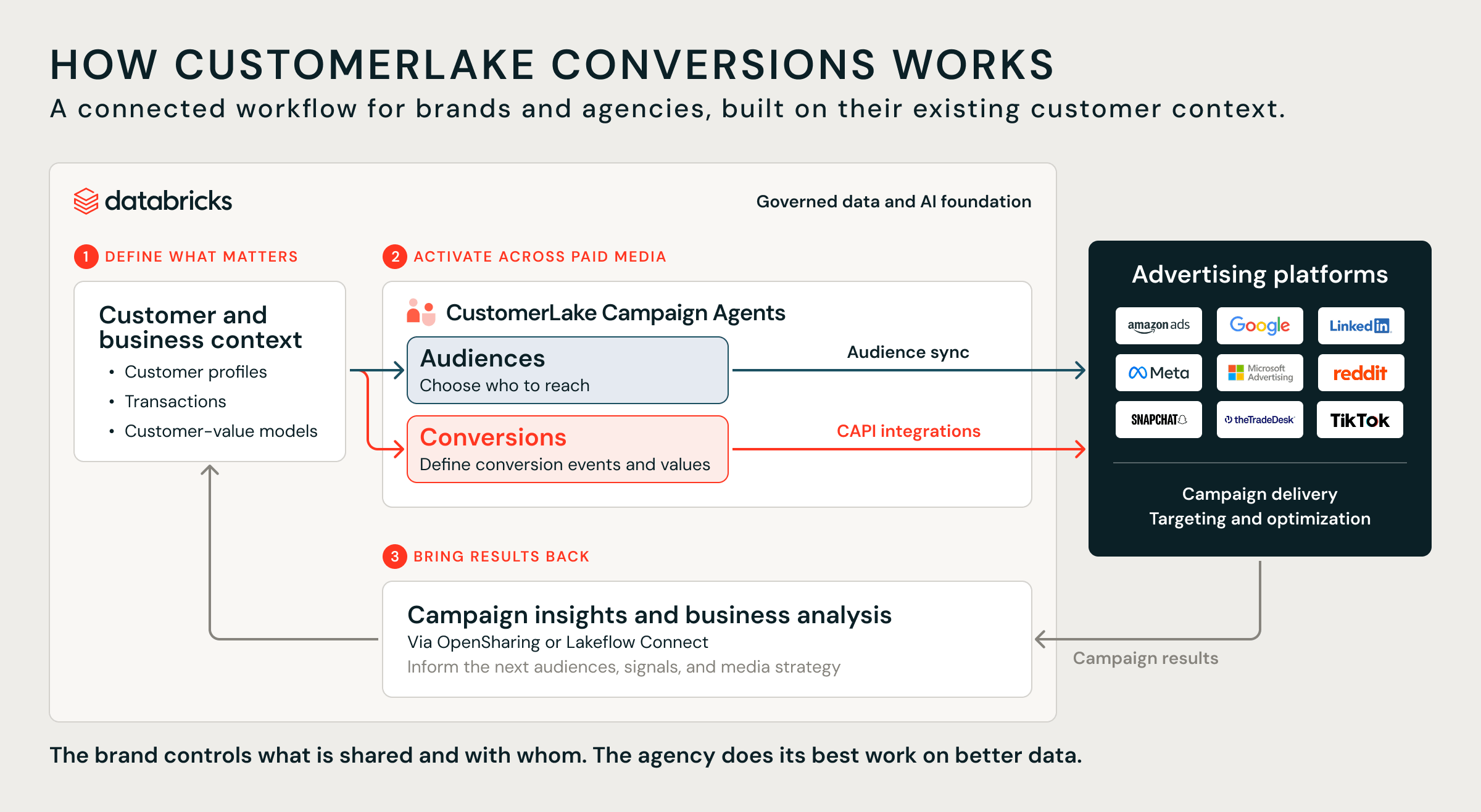
CustomerLake Conversions extends Campaign Agents to advertising performance by connecting three steps directly on your trusted foundation:
- Define what matters. Use first-party data and ML models to build audiences and identify meaningful conversion signals, such as a qualified lead or a first purchase from a customer predicted to be high value.
- Activate across paid media. Audience and Conversions API (CAPI) integrations deliver selected audiences and conversion signals, through native Reverse ETL connectors, to advertising platforms.
- Bring results back. OpenSharing integrations and Lakeflow Connect bring campaign insights back into Databricks, where teams can evaluate advertising performance alongside customer and business context.
The dedicated Conversions tab within CustomerLake Campaign Agents lets marketers select conversion data, configure destinations, and manage delivery within the Campaign Agents workflow.
Together, these capabilities connect the intelligence behind your targeting, the signals sent to platforms, and the results used to guide future investment.
Providing better signals to advertising algorithms
As advertising platforms automate more bidding, targeting, and campaign decisions, the only lever advertisers fully control is what signals they feed them. That puts a premium on first-party data, and on the business context that explains what it means.
However, getting richer business context into paid media often requires manual data extracts, custom integrations, and handoffs across marketing, analytics, engineering, and agency teams. Audiences can diverge across platforms, and campaign reporting is delayed and disconnected from customer and revenue data.
That means attribution is fuzzy, acquisition costs creep up, and teams can't say with confidence which paid channels are converting and which aren’t.
CustomerLake Conversions brings signal creation and activation to where customer data and models already live. A retailer can use predicted lifetime value to rapidly adjust lookalike targeting. A B2B company can use qualified leads or closed won revenue to represent progress beyond a submitted form. Marketers still define success; CustomerLake helps translate those priorities into signals advertising platforms can use.
CustomerLake Conversions in practice: From purchase events to customer value signals
Let’s consider a retailer whose goal is to acquire more customers who are likely to buy again.
Before: The retailer sends purchase events and order values to its advertising platforms, while its lifetime value model lives in the data platform, maintained by the data team. Using that model in paid media requires data extracts, platform-specific uploads, and separate delivery workflows. Their agency then reconciles campaign reports with revenue data to evaluate acquisition quality.
With CustomerLake Conversions: The paid media team uses its existing lifetime value model in Databricks to identify completed first purchases from customers likely to become repeat buyers. In the Conversions tab, the team configures delivery of those purchase events to supported advertising platforms through CAPI. The same customer data can also inform the audiences the team builds and syncs.
Campaign insights flow back into Databricks, where the retailer and its agency evaluate acquisition spend alongside customer value. They can refine audiences, signals, and media strategy using the same customer and business context that informed activation.
The result? The ad platform can better optimize what a good customer looks like. The retailer gets a faster, clearer view of which campaigns acquire the customers it wants to grow with.
Built for brands and the agencies supporting them
For many enterprises, agencies provide core strategy, identity assets, models, and media expertise that turn customer intelligence into performance.
CustomerLake Conversions gives brands and agencies a shared foundation for that work. Agencies get governed access to customer context in the lakehouse, without copying or duplicating data. The brand controls what is shared and with whom, and the agency does its best work on better data. In practice, what this could look like:
- Configure delivery. Agencies can set up destinations and conversion definitions in the client's CustomerLake Conversions tab, using permissions the brand delegates, with an audit trail of what was sent where.
- Apply unique intelligence. Agencies can combine their identity data and predictive models, such as lifetime value and propensity scores, with a brand’s first-party data to build more relevant audiences and conversion signals. For example, Epsilon’s identity graph can connect conversion events to customer identities even when the original event has limited identifying information. Adding those identifiers to the data sent via CAPI can help ad platforms match more conversions, giving advertisers a fuller picture of how their campaigns perform and giving platforms more signals to optimize delivery.
- Measure results. Campaign insights from the platforms feed the agency's MMM and incrementality studies.
The brand brings customer understanding. The agency brings its expertise in reaching and engaging them. CustomerLake connects both to activation.
Customer context, shared on your terms
Activating richer customer context requires clear control over its use. CustomerLake Conversions is designed so customers own their data and stay in control:
- Your data stays governed. Customer profiles and business context are secured and governed by Unity Catalog.
- You choose the destinations. You decide which audiences and conversion events go to which platforms.
- You can see what was sent. An audit trail provides visibility into what was sent and where.
- Humans stay in the loop. Your team sets the strategy, goals and guardrails. Agents help scale execution.
The future: Advertising that learns as your customers change
Today, campaigns outlive the assumptions they launched with. A single campaign can take 6+ teams and 60+ days to launch. By then, customers have moved on.
CustomerLake enables a continuous operating model, where each customer interaction helps inform the next decision. As campaign results feed back into the same Data + AI foundation, agents can help marketers and agencies recognize changes, recommend adjustments, and keep activation aligned with business goals. People define what matters, set the strategy, and establish the guardrails; agents help execution keep pace with customer demand.
CustomerLake Conversions brings paid media into the broader vision of Infinity Campaigns: continuous engagement that learns and adapts as customer context changes. It advances our mission of marketing in context: turning everything you know about your customers into growth.
To get started with CustomerLake Conversions, contact your Databricks account team.
Get the latest posts in your inbox
Subscribe to our blog and get the latest posts delivered to your inbox.