Databricks for Healthcare and Life Sciences
AI, apps and agents – built and run on your healthcare data
Your data, your patients, your breakthroughs
See how healthcare and life sciences leaders unify clinical, claims and research data to power analytics, operational apps and AI agents – all on one governed platform.
Increase R&D productivity
Accelerate drug discovery
Train multimodal models on multi-omics, imaging and scientific data, then let scientists query everything in plain English with Genie.
Streamline clinical development
Automate site selection, protocol design and clinical data QA with agents shaped by your CROs and medical teams.
Build a FAIR data foundation
Make scientific data Findable, Accessible, Interoperable and Reusable with Unity Catalog lineage spanning omics, imaging and trials.
Optimize supply chain and manufacturing
Create end-to-end supply chain visibility
Stream ERP, SAP, supplier, inventory and distribution data into Lakebase to monitor OTIF in real time and predict shortables before they hit.
Forecast demand and optimize inventory
Use ML to forecast demand, optimize safety stock and dynamically route inventory across global networks – refreshed in near-real-time.
Implement smart manufacturing
Run digital twins, predictive maintenance and IoT analytics for biologics and cell therapy at scale, with full lineage and CQA tracking.

Improve commercial effectiveness
Generate real-world evidence
Standardize claims, EHR, registry and patient data with OMOP, build cohorts and ship RWE studies with full Unity Catalog support.
Deliver provider next-best-action (NBA)
Unify HCP, claims, CRM and specialty pharmacy data, then deploy NBA agents with Agent Bricks that recommend channel, message and timing.
Improve patient engagement and adherence
Power digital health apps with Lakebase to serve real-time patient profiles, adherence data and connected-device telemetry.


Outcomes proven by healthcare and life sciences leaders
From discovery to revenue cycle, the world’s leading healthcare and life sciences organizations build on Databricks.Featured products
Run analytics, operational apps and AI agents on the same governed copy of your healthcare and life sciences data.


Health and life sciences partner ecosystem
An ecosystem of healthcare, life sciences, cloud and data partners helping organizations improve patient outcomes, accelerate research and power AI-driven innovation.
Resources
Guide

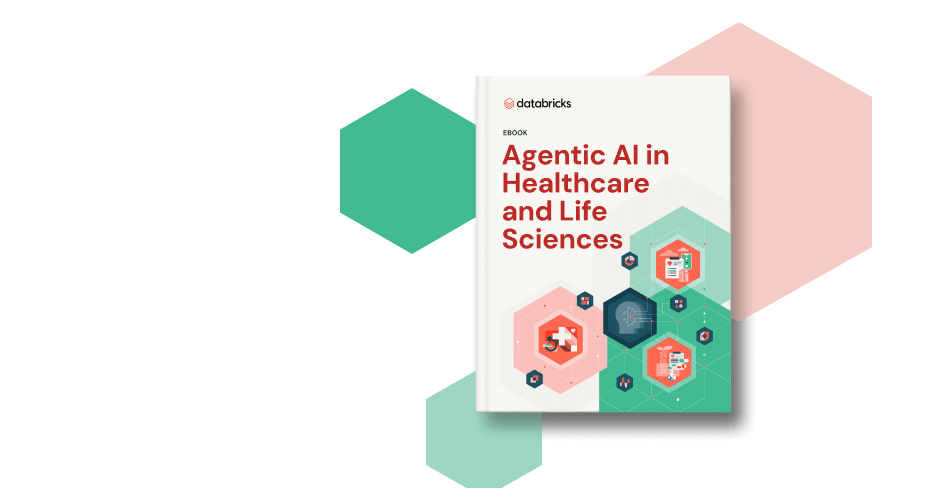
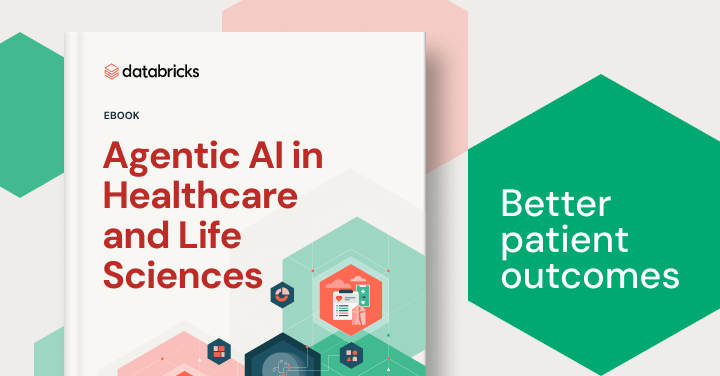
eBook
Executive Brief
Video Episode

FAQ
In healthcare and life sciences, the challenge isn't a shortage of data, it's activating it safely across clinical, operational and research workflows. Databricks provides the unified foundation to build and run AI, apps and agents on the same governed copy of your data:
- Conversational insights with Genie: Clinical, quality and operations teams can ask questions like "What's our 30-day readmission rate for sepsis patients?" and get governed answers in plain English — no SQL required, no waiting on data teams.
- Real-time operational apps with Lakebase: Organizations use Lakebase, our operational database for the AI age, to power real-time applications directly on enterprise data, from revenue cycle automation to prior authorization workflows, without moving or duplicating data.
- Production-grade AI agents with Agent Bricks: Teams use Agent Bricks to build and govern autonomous agents for complex tasks like clinical note abstraction, pharmacovigilance monitoring and next-best-action for provider engagement — all shaped by your domain experts and governed by Unity Catalog.
AI enables healthcare providers to shift from reactive reporting to proactive, real-time intervention, identifying at-risk patients before they deteriorate.
- Predictive risk models at scale: Using Agent Bricks, organizations train models on EHR, claims, genomic, device and social determinants of health (SDoH) data to identify high-risk patients earlier and surface them to care teams automatically.
- Real-time patient apps with Lakebase: Because Lakebase separates compute and storage, it delivers the low-latency, high-concurrency foundation needed to power patient- and clinician-facing applications across millions of records simultaneously.
- Population health insights with Genie: Quality and care management teams can ask questions like, "Which patient cohorts missed their follow-up appointments last quarter?" to identify gaps, measure intervention ROI and adjust programs in near real time.
Life sciences companies use Databricks to compress the timeline from molecule to market by unifying scientific data and putting AI directly in the hands of researchers.
- Multimodal research with Agent Bricks: Scientists train models on multi-omics, imaging and clinical trial data — then use Genie to query petabytes of scientific data in plain English, turning weeks of analysis into hours.
- Automated clinical workflows with Agent Bricks: Teams deploy production-grade agents to automate site selection, protocol design, clinical data QA and secondary data use — governed by the security and lineage controls researchers and regulators require.
- FAIR data foundation with Unity Catalog: Unity Catalog enforces lineage, access control and reproducibility across omics, imaging and trial data — making scientific data Findable, Accessible, Interoperable and Reusable from discovery through submission.
A data lakehouse is an open, unified architecture that combines the cost-effective, flexible storage of a data lake with the performance and governance of a data warehouse. For healthcare and life sciences organizations, it provides the essential foundation for the AI era:
- One governed home for all data types: Structured claims, unstructured clinical notes, FHIR/HL7 feeds, DICOM imaging and genomic files all live on a single platform, eliminating the costly, risky practice of duplicating data across siloed systems.
- Lakebase for AI-native apps: The lakehouse architecture is extended by Lakebase, which provides an operational database capability so real-time patient, provider and member applications can read and write directly to the same governed data used for analytics and AI.
- Unified governance for agents and humans: Through Unity Catalog, every AI agent built with Agent Bricks inherits the same identity, security and access permissions defined for human users, ensuring that AI initiatives remain safe, compliant and auditable across PHI-sensitive environments.
- Democratized intelligence across the enterprise: By integrating Genie, the lakehouse allows everyone, from bedside nurses to the C-suite, to extract value from data using natural language, making data intelligence a capability for the whole organization, not just data teams.