Database for AI Agents: 5 Evaluation Criteria
Learn the 5 criteria for evaluating a database for AI agents — branch isolation, serverless scaling, hybrid search, ACID guarantees, and unified access.
- AI agents need a database that supports continuous, concurrent reads and writes across multiple memory types — not the one-request-at-a-time pattern traditional apps use.
- Five criteria define a production-ready agent database: branch-per-agent isolation, scale-to-zero compute, hybrid search in a single query, ACID guarantees under concurrency, and a unified platform with no ETL lag.
- Databricks' Lakebase meets each criterion, with real-world validation from Superhuman and easyJet.
The five criteria for evaluating a database for AI agents are branch isolation, serverless scaling, hybrid search, ACID guarantees, and unified platform access. Together, these criteria help developers and data teams determine whether a database can support agents as they move from prototypes into production and begin handling concurrent tasks, live operational data, and persistent state.
A database for AI agents is a system designed to store the state, memory, tool results, and operational data an agent needs to complete tasks across multiple steps and sessions. Unlike a database serving a conventional application, it needs to support repeated reads and writes, concurrent agent activity, retrieval across different types of memory, and access to current operational data.
The rise of AI agents makes these requirements more important. When developers run coding agents, customer support agents, or multi-tenant platforms, agents do more than retrieve information. They write state, resume tasks, coordinate tool calls, and act on changing operational data. As data teams move agents into production, database limitations can create stale memory, conflicting writes, latency, and unnecessary compute costs.
Why a Database for AI Agents Is Not the Same Problem
A production-ready agent needs to remember what it already did, pick up a task where it left off, and pull in the right context before it acts. Pair it with the wrong database, and that memory can become stale, incomplete, or inconsistent.
Production agents lean on four memory layers to pull this off:
- Short-term memory: the in-context working memory available during the current interaction, including recent messages, retrieved information, and tool results.
- Episodic memory: past interactions that let an agent recall earlier conversations, user preferences, and completed tasks.
- Procedural memory: the workflows, tool definitions, and instructions that guide how tasks are carried out, whether they're stored externally or built into the model.
- Operational state: the live status of the task, including completed and pending steps, tool outputs, and checkpoints for resuming work later.
That's a more involved workload than a typical application, which sends a query to the database and moves on. Most production databases are operational databases, also called online transaction processing (OLTP) systems, built around that same one-request-at-a-time pattern. An agent doesn't work that way. It issues read after read and write after write within a single task, with no human pause between them, while hundreds of other agents are doing the same thing.
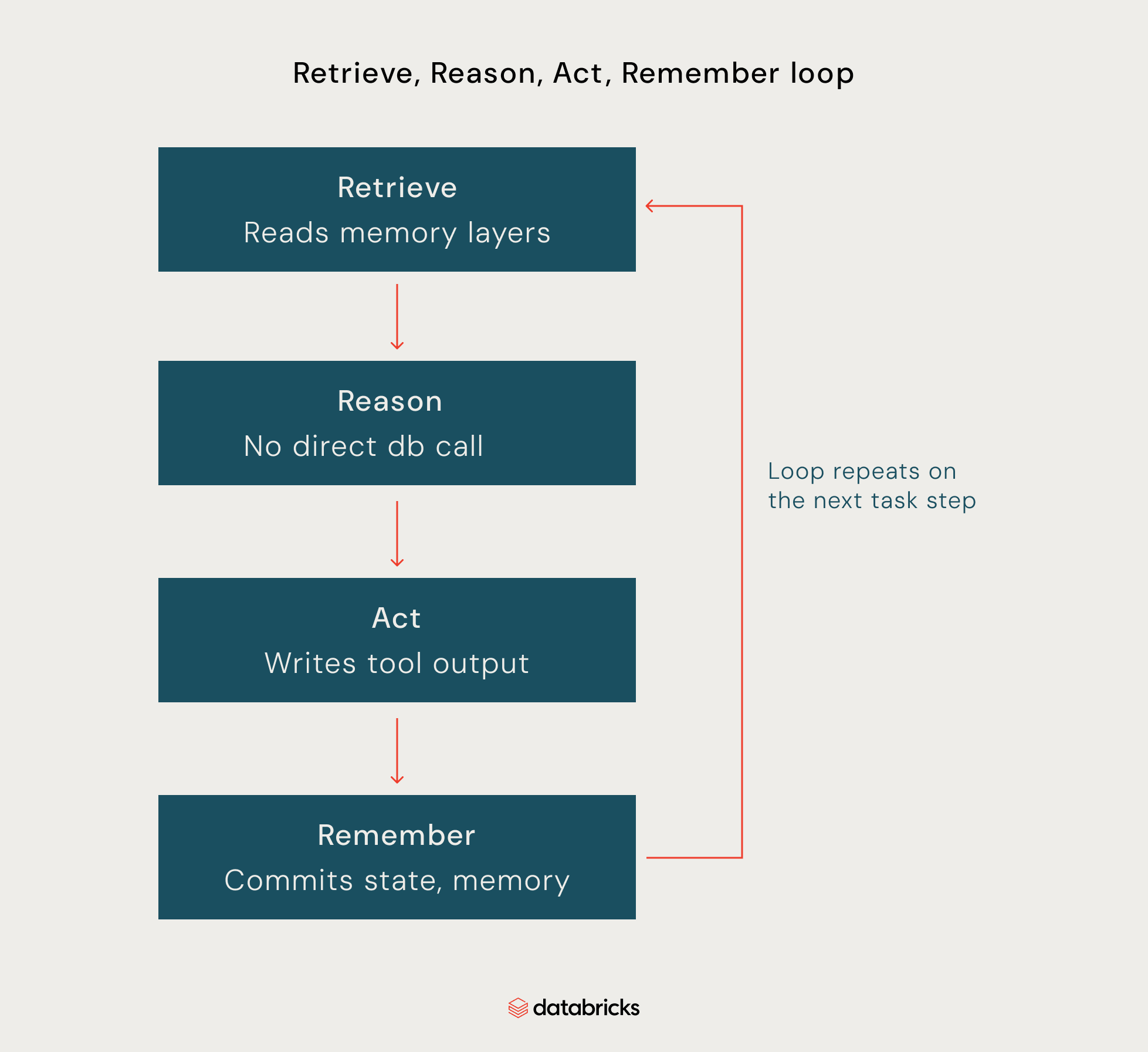
The 5 Criteria for Evaluating Any Database for AI Agent Workloads
When selecting a database for AI agents, several criteria matter, but these five are the ones worth evaluating regardless of which vendor is under consideration, managed or self-hosted.
Branch per agent: Safe testing against real data
Testing an agent only against synthetic data is like testing a support system with a handful of perfectly formatted customer accounts. It might behave exactly as expected, but real accounts are always messier. Data teams eventually hit missing fields, inconsistent records, old data, and edge cases that never made it into their test fixtures.
That's why we recommend treating isolated testing against real data as a database evaluation criterion. The goal is for the agent to work with a production-like state without giving it a way to modify production. One way to get that isolation is zero-copy branching, which lets developers create a separate environment without maintaining a second full copy of the database.
Lakebase Projects is designed to handle this kind of isolated development and testing by letting developers create branches from production data without copying the underlying data. Branching a terabyte-scale production database takes about a second, with no additional storage cost until the branch diverges from its parent.
Scale to zero: How serverless pricing changes agent economics
27% of cloud spend goes to waste every year, and idle, underutilized compute is consistently the biggest driver of it. Agent databases are a clean example of why. Most agents don't run continuously. They wake up, do a task, write the results, then go quiet until the next request comes in. Paying for dedicated compute around the clock means paying for that same idle-compute problem across every agent database a team is running.
A serverless scale-to-zero model addresses this by suspending compute after a period with no active connections and resuming it when work starts again. That makes costs track actual usage instead of idle time. Startup speed matters just as much as the savings, though. An agent waiting 20 or 30 seconds for its database to wake up isn't practical, especially when it's responding to a user or waiting on the next tool call.
Lakebase uses this model for Postgres, with compute resuming within a few hundred milliseconds of a new query. That keeps the startup delay small enough for scale-to-zero to work with interactive agent workloads.
Hybrid Search: Retrieving Across All Four Memory Layers in One Query
Vector search alone is like a librarian who can only browse by "what feels similar," never by an exact call number. Ask it to find documents about database architecture, and it'll do well. Ask it for the record with account ID 48291, and it has no reliable way to land on it. Semantic similarity isn't built for exact matches.
That's the gap many retrieval-augmented generation (RAG) pipelines run into when they rely on vector search alone. Hybrid search closes it by combining vector similarity, keyword matching, and metadata filtering in a single query instead of stitching results together from separate systems. Split that across a vector index and a relational store, and the agent makes two calls instead of one. The systems can drift out of sync, and every extra hop adds latency an agent's loop can't always absorb. Retrieval needs to land well under 100 milliseconds to stay usable inside a tight reasoning cycle.
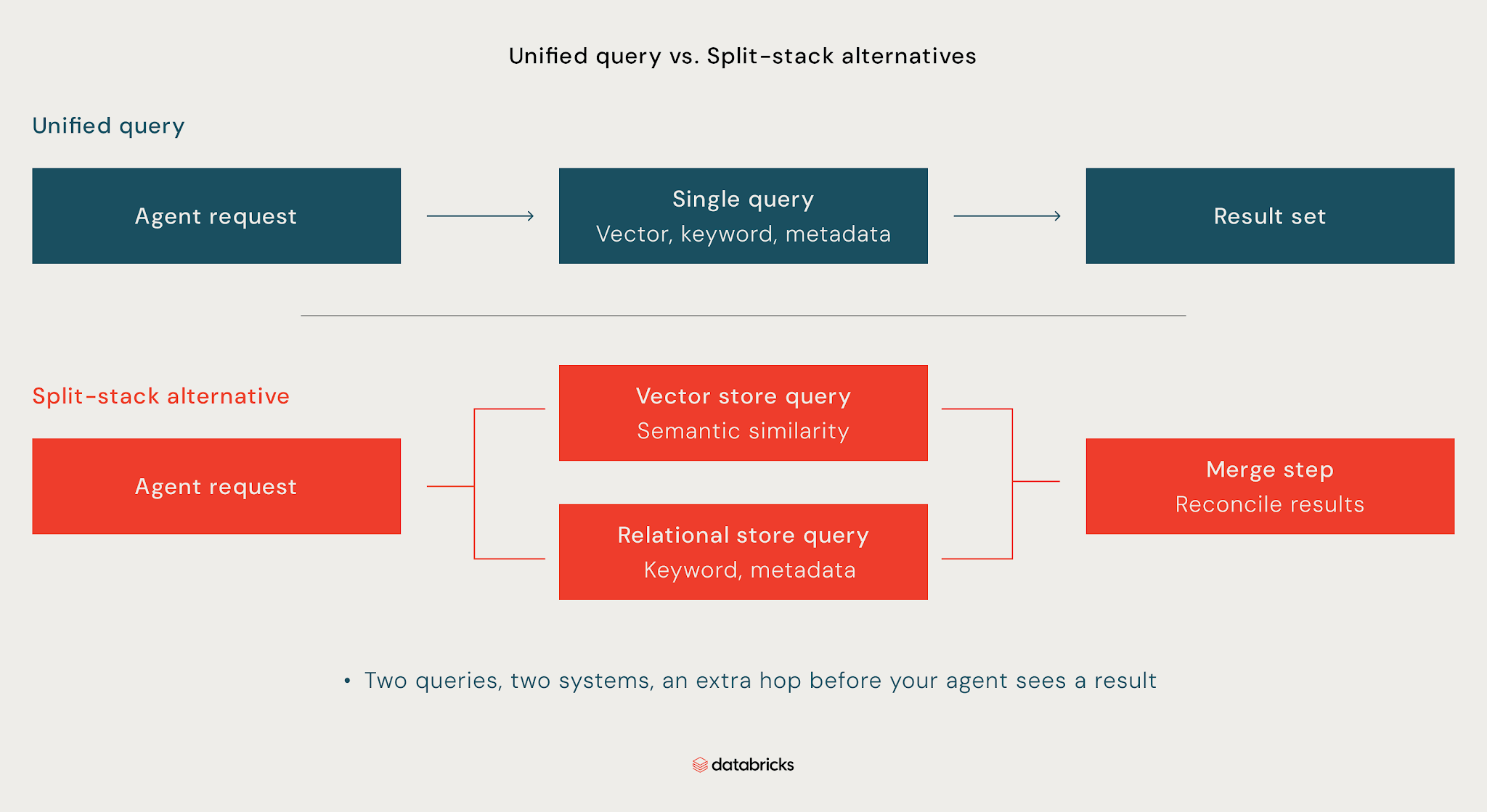
Lakebase Search runs vector, keyword, and metadata queries against the same Postgres tables where operational data already lives, so there's no second system to fall out of sync with. Its LTAP architecture is what keeps that data current, with write performance up to 5 times faster than standard Postgres. That means what an agent just wrote can be available for retrieval almost immediately.
ACID guarantees for multi-agent systems
Picture two support agents updating the same customer record at the same time. One is resolving a billing issue and adjusting the subscription tier, while the other is logging a refund. Without proper isolation, one update can overwrite the other, leaving the record in a state neither agent intended.
That's why transactional guarantees should be a hard criterion when evaluating a database for multi-agent workloads. ACID gives developers four properties to check:
- Atomicity: a transaction either completes fully or not at all.
- Consistency: the database stays valid before and after every transaction.
- Isolation: concurrent transactions don't interfere with each other's work in unexpected ways.
- Durability: a committed write survives a crash or restart.
For multi-agent systems, the practical questions matter more than the acronym. Can a tool-output commit happen atomically, so a half-finished action never gets treated as complete? What happens when two agents update the same record? Which isolation levels does the database support? Can an agent resume after a restart without losing committed state?
When comparing databases, we recommend checking the isolation levels and commit semantics they actually support, not just whether they claim to "support transactions." Once multiple agents share operational data, those details determine whether concurrent work stays predictable.
Unified Platform: Operational Data in the AI Stack Without ETL
An agent waiting for a pipeline to catch up is making decisions on stale data. By the time that pipeline runs, the record it's acting on may have already changed again. When evaluating a database, look at how closely it connects operational data with the analytics and AI systems that depend on it.
A unified platform keeps operational writes and analytical reads on the same data, without a separate extract, transform, load (ETL) pipeline sitting between them. Your agents can work with current data, while your models can use live outcomes instead of waiting for a batch job. Data teams also keep governance and audit trails in the same platform, rather than pushing agent workloads into a separate system that's harder to track. Unity Catalog is what enforces that governance layer across both operational and analytical data in Databricks. Superhuman's experience shows what this looks like in practice: replacing custom sync pipelines into a caching layer and a managed NoSQL store with a unified platform cut its data integration timeline from nearly three months to about two weeks.
easyJet took a similar approach in its revenue management stack. Since moving to Lakebase, the airline has captured live booking and pricing activity alongside analytics on the same lakehouse data, consolidated more than 100 Git repositories into two, and cut app development cycles from six to nine months to about four.
Lakebase keeps operational data in the Databricks lakehouse, so the same data can support transactional workloads and downstream analytics without a separate ETL pipeline.
The agentic AI playbook for the enterprise

AI Agent Database Evaluation Scorecard
Run any candidate through these five checks, and you'll know within minutes where it holds up and where it doesn't, regardless of which vendor you're comparing.
| Criterion | What to test | Minimum bar | Red flags | Lakebase behavior |
|---|---|---|---|---|
| Branch per agent | Can you spin up an isolated branch against real production data without making a full copy? | Branch creation completes in seconds, not minutes | Requires a full database copy, or takes longer than your test cycle | Branches a terabyte-scale database in about a second, with no storage cost until it diverges |
| Scale to zero | Does compute suspend after a period of no activity and resume fast enough to stay usable? | Compute resumes in under a second, no manual wake-up step | Cold start takes 10+ seconds, or idle databases still bill at full rate | Reactivates within a few hundred milliseconds and bills nothing while suspended |
| Hybrid search | Can one query combine vector similarity, keyword matching, and a structured filter? | Single query, under 100ms | Requires separate calls to a vector store and a relational store, then a manual merge | Runs vector, keyword, and metadata queries against the same Postgres tables |
| ACID guarantees | Can two agents write to the same record at once without losing either write? | No lost writes; isolation holds under concurrent load | Silent overwrites, or isolation that degrades under concurrency | Standard Postgres transactional guarantees, unaffected by concurrent agent load |
| Unified platform | How long does a new write take to become available for analytics? | No ETL step, or lag measured in seconds, not hours | Requires a scheduled pipeline before data is queryable elsewhere | Every write becomes queryable in the Databricks lakehouse without a separate pipeline |
A database failing more than one of these minimum bars is a production risk once you're running agents at scale, not just a minor tradeoff you can work around later.
Wrapping Up
Choosing a database for AI agents comes down to workload fit, not feature lists. The five criteria in this guide give developers and data teams a practical framework for evaluating any database before committing to it in production. If a candidate can't meet those requirements today, production agents will eventually expose the gaps as they take on more users, more tasks, and more concurrent work.
If you're evaluating a database for AI agents, explore Lakebase to see how Databricks supports transactional workloads, branching, serverless scaling, hybrid search, and unified access to operational data.
Frequently Asked Questions
Do AI agents need a database?
Yes. Most agent implementations don't retain short-term context, episodic history, procedural knowledge, or live task state across calls unless you explicitly persist and reload it. Without a database behind it, your agent typically loses that context the moment a session ends and can't pick up a task where it left off.
Is a vector database enough for AI agents?
Not on its own. A vector database handles semantic retrieval well, but your agent also needs to write and update operational state, enforce transactional integrity across concurrent writes, and filter on structured fields a similarity search can't reliably catch. Semantic search covers one piece of what an agent needs, not the whole workload.
What is the best database for RAG in AI agents?
There's no single right answer. For RAG in AI agents, the best database is the one that can run hybrid search in one query, keep retrieval fast enough for the agent loop, and stay current enough to avoid stale memory.
How do multi-agent systems change database requirements?
Once multiple agents write to shared data at the same time, transactional integrity stops being optional. Your database needs to isolate concurrent writes so one agent's update doesn't silently overwrite another's, and it needs to commit tool outputs atomically so a half-finished action never gets treated as complete.
What is the difference between OLTP and OLAP for AI agents?
Your agent's live actions, writing tool outputs, updating state, and checkpointing progress are OLTP workloads. Reporting and model training on top of that data are OLAP workloads. Agents typically need both to work from the same data without a pipeline between them. That's why the criteria in this guide focus on databases that can serve both transaction-heavy agent work and downstream analytics from the same data.
Is Postgres good for AI agents?
Standard Postgres provides solid ACID guarantees and a mature ecosystem, covering part of what your agent needs. It doesn't provide zero-copy branching, scale-to-zero compute, or unified operational and analytical access by itself; those depend on the platform built around it.
Get the latest posts in your inbox
Subscribe to our blog and get the latest posts delivered to your inbox.