Empower your healthcare agents with ready-to-use MCP on Databricks Marketplace
by Yen Low, Mark Lee, Matthew Giglia, Nicholas Siebenlist, Jay Bhankharia, Paul Ford and Itai Weiss
- Supercharge your agents with key biomedical and clinical Model Context Protocol (MCP) servers on our Marketplace, provided by our partners Climb, Atropos Health, Kythera Labs and Redox.
- Add your own MCP servers or data to your agents. All MCP servers are securely governed in our centralized MCP Catalog.
- Learn how to easily build and deploy bespoke agents to production no matter your developer experience.
While there holds great promise for AI agents to transform the healthcare industry, for agents to be successful, they require a sophisticated integration of curated knowledge, timely data, and specialized tools. This is where the Model Context Protocol (MCP) as an open standard interface is key to integrating all the above add-ons to supercharge agents with the appropriate capabilities.
Barriers to Agent Adoption in Healthcare
Building effective AI agents in healthcare presents unique challenges. First, healthcare workflows demand highly specialized and curated knowledge, ranging from genomic data to clinical guidelines, that is difficult to build from scratch. Generic large language models (LLM) often lack the specialized information needed for drug discovery or clinical decision support. Furthermore, given the higher stakes in healthcare, LLMs need grounded context and direct access to purpose-built tools to provide safe and accurate answers.
Traditionally, healthcare data and tools have remained siloed across disparate systems, requiring massive engineering efforts to integrate and creating significant barriers to AI adoption. As such, healthcare professionals continue to labor in paper-heavy and data-intensive workflows, exactly the kind of tasks that agents are designed to simplify and alleviate.
Databricks as a Unified Agent Ecosystem with Re-usable Building Bricks including MCP servers
Databricks already provides a full-service agent ecosystem where it is easy to discover and reuse essential building blocks—including MCP servers, function tools, Genie spaces and Vector Search —all governed under the robust security of Unity Catalog.
New MCP servers on Databricks Marketplace
We are making it easier than ever to jumpstart development with ready-to-use MCP servers on the Databricks Marketplace. With these MCP servers, you can introduce new capabilities like:
MCP Servers Provided by Climb | |
   | Generate hypotheses from disease-target-drug interactions or look up bioactivity including toxicity: |

| Search for biomedical literature: |
 | Query clinicaltrials.gov to learn about current trials and their status: |
 | Examine drug product labels and drug/device safety information: |
 | Query Medicare coverage policies: |
 | Search ontologies: |
Additional MCP Providers on Databricks Marketplace | |
 | Get answers to clinical questions with proprietary real-world evidence in Alexandria, the Atropos Evidence Library |
 | Kythera’s Medical Semantics Gateway turns complex healthcare data into accessible, queryable, and actionable intelligence. |
 | Design and manage healthcare data integrations using natural language with Redox MCP |
Climb
We partnered with Climb, a trusted Databricks systems integrator partner, to provide direct access to key biomedical MCP servers, including PubMed, Clinicaltrials.gov and US Census.
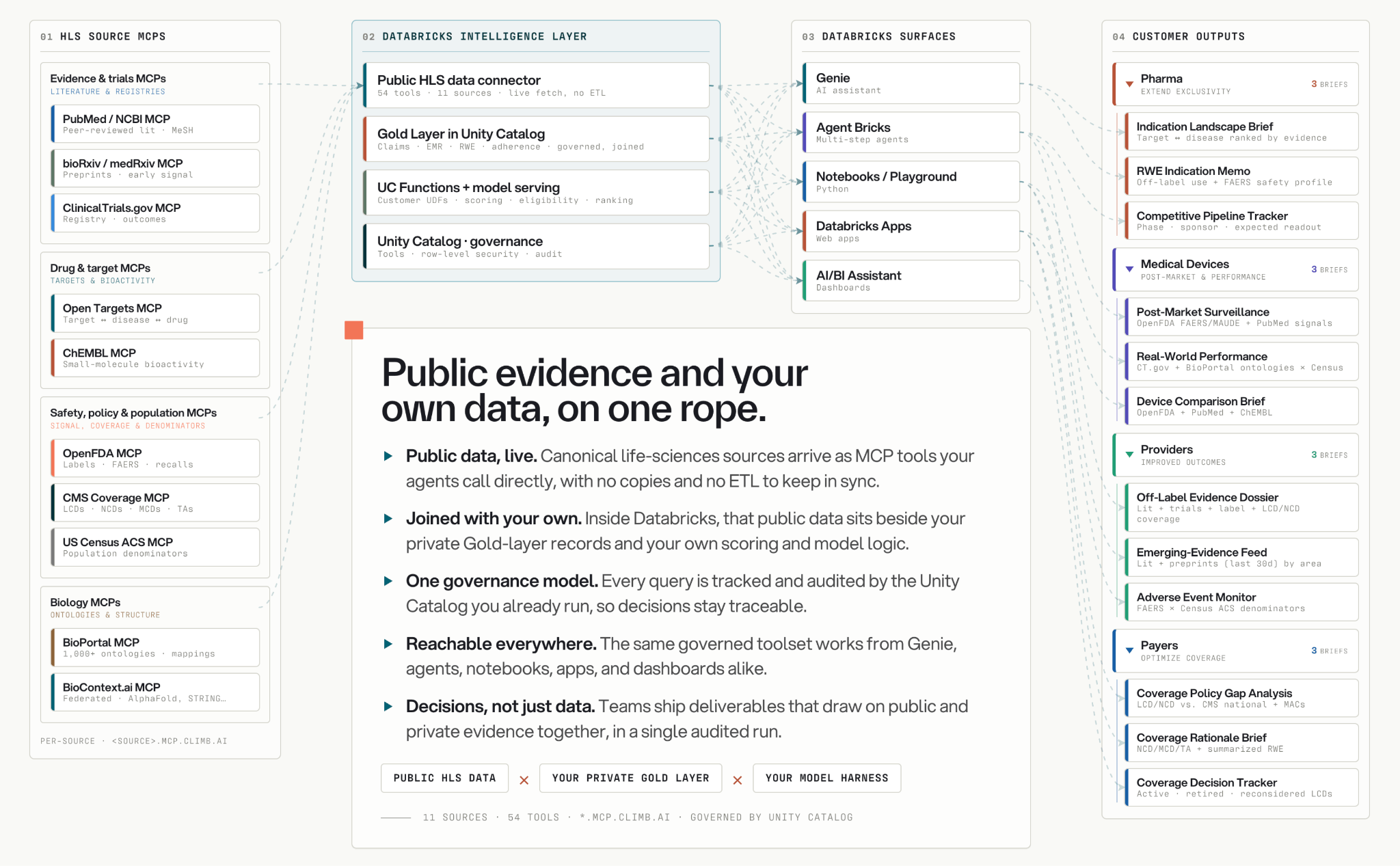
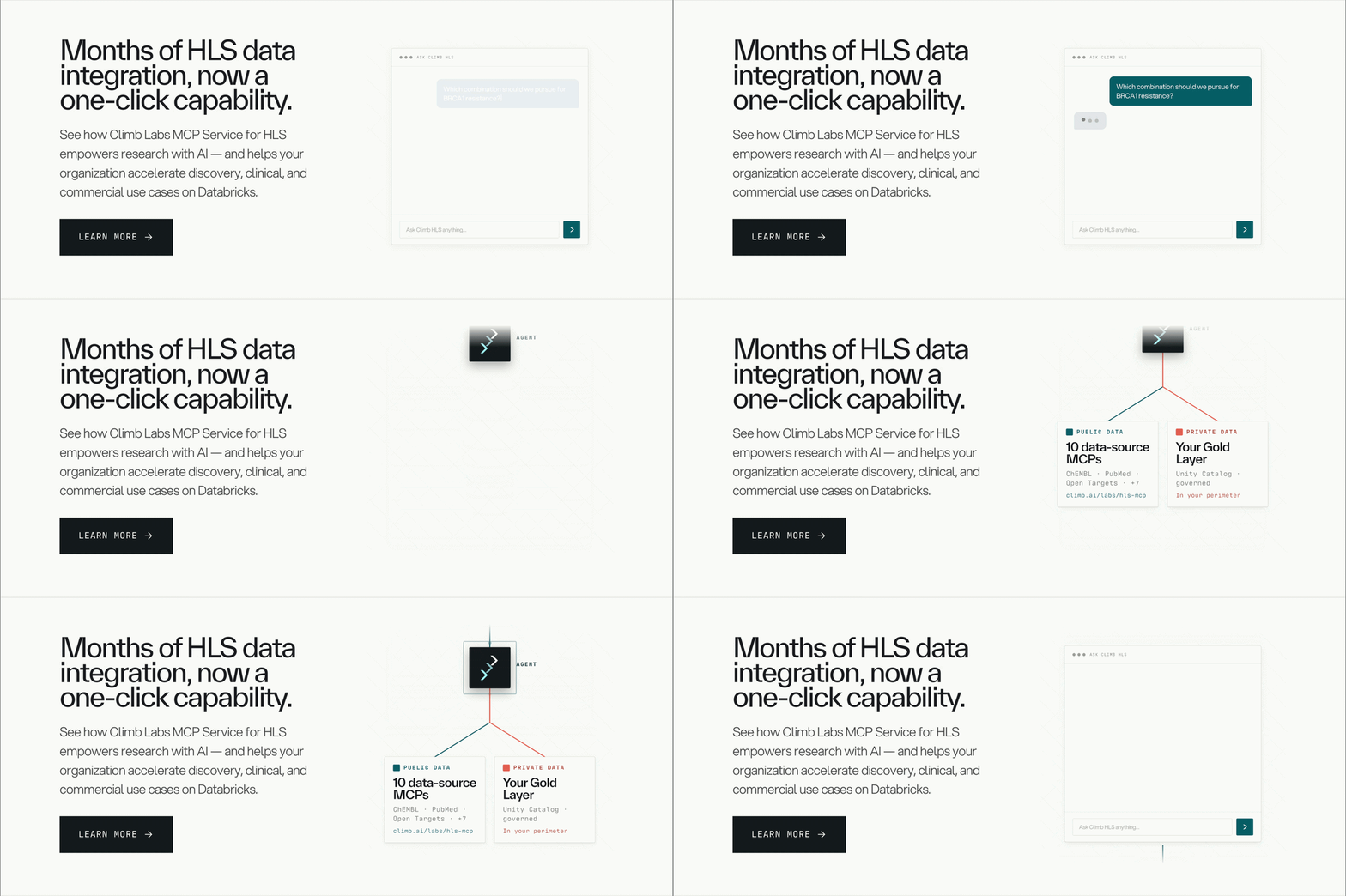
The diagram above shows how Climb brings public life-sciences data and your own private data together in your Databricks workspace. Canonical public sources are connected through live MCP services, with no copies and ETL to keep in sync. Inside Databricks they meet your private Gold-layer records and your own models, all under the Unity Catalog governance you already run. From surfaces like Genie and Agent Bricks, your teams can query public and private evidence together, powering use cases like responder/non-responder dashboards and adverse-event monitoring, each in a single audited run.
Atropos Health
Atropos Health MCP enables quick access to Alexandria®, the Atropos Evidence™ Library, a collection of over 33M precision evidence based findings (pEPF™) and precision real-world evidence (pRWE™) summaries. These observational studies close the evidence gap on real world multi-morbid cohorts that are often underrepresented in clinical trials and other conventional studies. Additionally, it promotes evidence-based medicine and streamlines clinical operations by surfacing evidence relevant to individual patient profiles.
"The best partnerships don't just connect two products — they unlock something neither could offer alone. That's what being a Databricks Marketplace partner means to us. By bringing real-world evidence directly into the Data + AI Platform, we're giving life sciences and healthcare teams the ability to build AI applications grounded in clinical reality, not just data —and that changes what's actually possible."
- Dr. Brigham Hyde, CEO and co-founder of Atropos Health.
Kythera Labs
Kythera Labs provides clinical semantic infrastructure for healthcare AI, helping agents translate natural language clinical concepts into the standard medical vocabulary logic required to work with real-world healthcare data. The Kythera Clinical Semantic Translation MCP Server enables users to describe diseases, medications, procedures, laboratory tests, outcomes, and eligibility criteria in plain language and automatically translates them into retrieval-ready code sets across vocabularies such as ICD-10-CM, SNOMED CT, CPT, HCPCS, NDC, RxNorm, and LOINC. By bridging the gap between clinical language and structured healthcare data, Kythera accelerates cohort discovery, patient finding, clinical trial feasibility, commercial analytics, market access research, and real-world evidence generation. Rather than relying on manual code lookups or specialized healthcare data expertise, organizations can use Kythera's MCP server to quickly move from clinical questions to actionable insights, enabling AI agents and analysts to work more effectively across claims, EHR, pharmacy, laboratory, and research datasets.
Redox
Redox is your interoperability partner, powering intelligent healthcare data exchange at scale. Provider, payer, healthtech, EHR, and med tech organizations rely on Redox to connect, prepare, route, and execute complex data workflows across a connected network of more than 12,000 systems. The Redox MCP server helps customers manage and monitor real-time healthcare interoperability feeds using natural language. Creating a new integration connection historically required a technical user to navigate multiple screens, or chain together multiple Platform API calls to set up in a repeatable pattern. This blog shows how nearly any user can use the Redox MCP server to set up a new integration, test it, review the output, move it to production, monitor the logs, and review the real-time data flowing into Databricks, all in one session.
Centralized discovery and governance for MCP Servers
You can also bring your own MCP servers by adding them to our MCP Catalog. These can be MCP servers externally hosted or hosted on Databricks Apps. Additionally, many Databricks resources like Genie Spaces, AI Search, Unity Catalog functions and SQL Warehouses are also available as Managed MCP servers. More crucially, because your data is already on Databricks, you can use it to build bespoke agents to unlock valuable insights from your data assets.
All MCP servers, whether sourced from the Databricks Marketplace or your own custom builds, are centralized in the Databricks MCP Catalog and governed by our Unity AI Gateway to ensure fine-grained, secure access.
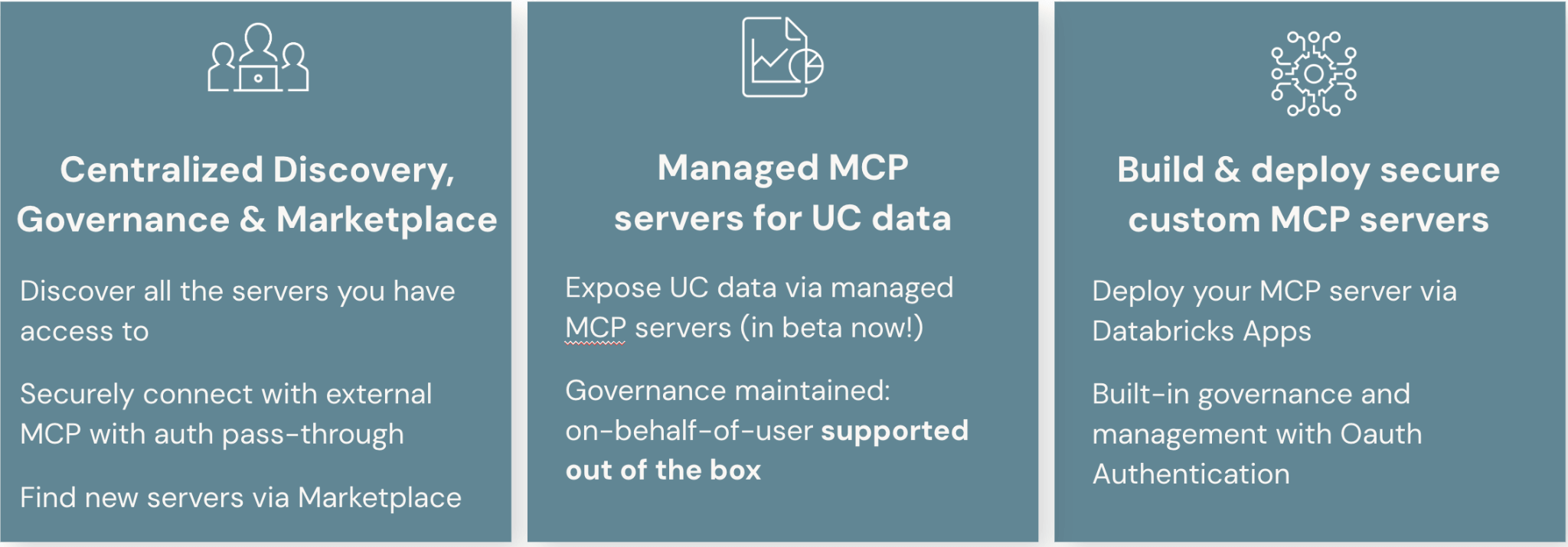
All MCP servers, whether from an external host or hosted on Databricks, are centralized and governed in the Databricks MCP Catalog for fast discovery and re-usability.
Empower everyone to extract agentic insights from your data
Whether you prefer a low-code experience using Agent Bricks or flexible coding options with Databricks Notebooks (now with Genie Code AI assistance), both beginners and power users can easily build and deploy agents to production.
Databricks offers full observability of the agent workflows in MLflow traces and facilitates evaluation with built-in AI judges and custom scorers. Additionally, Databricks provides an accompanying Review App to collect expert human feedback. Once deployed, the agent is continuously monitored with AI guardrails to protect against malicious activity.
Adding MCP Servers to your Agent
Below we show how you can use these MCP servers, whether you are a beginner, intermediate or advanced Databricks user!
Beginner (2 mins): Quickstart with Playground
- Launch the MCP server from your Marketplace
- Go to the AI Playground. Select the Model and Tools and select the external MCP server(s).
You can start asking questions like “Give me the molecular properties for orforglipron”. If you have connected the ChEMBL MCP server, it should answer the following:
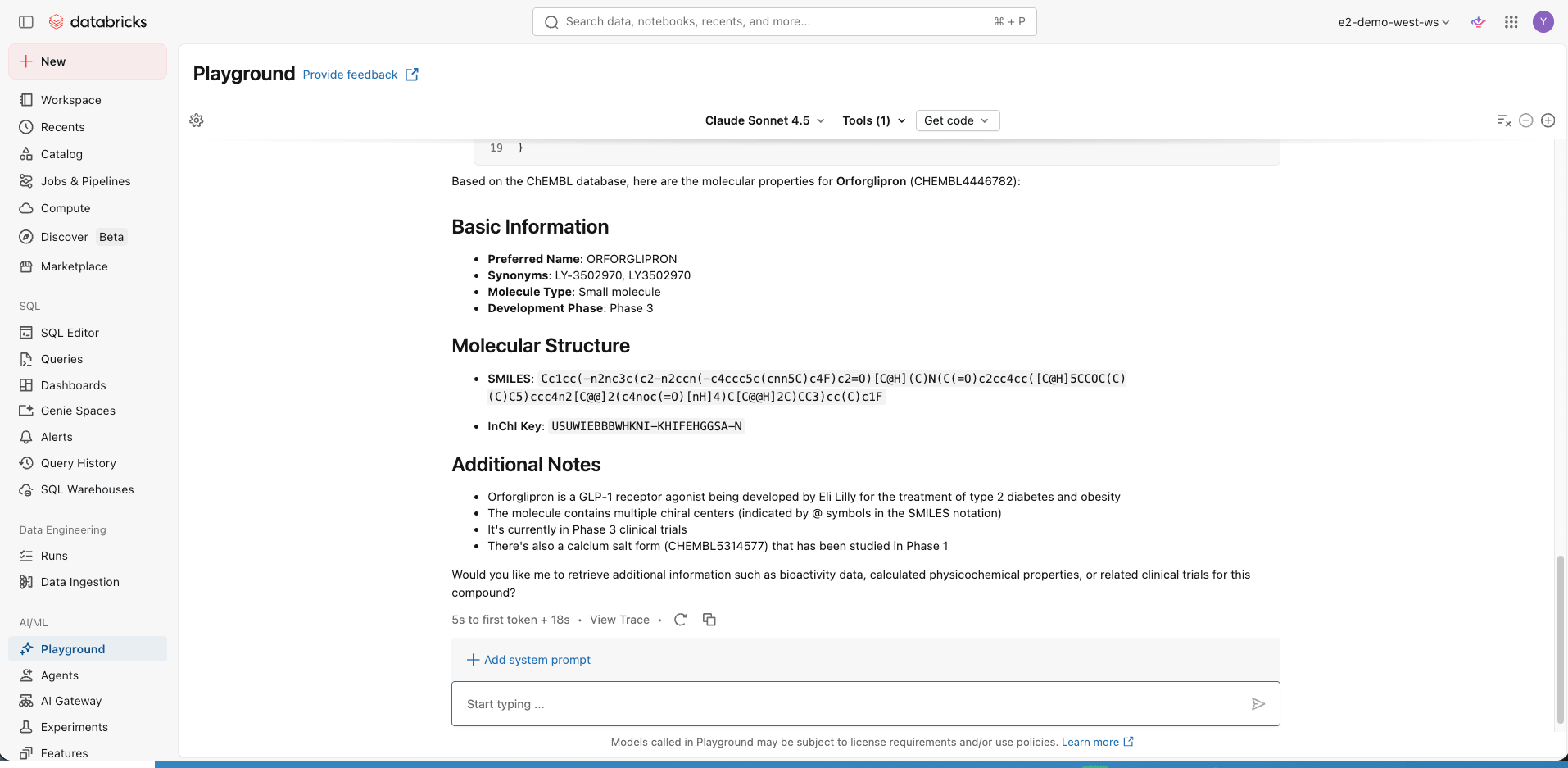
- If you’re satisfied with the progress, deploy this as a Databricks Apps by clicking the “Get Code” button. It deploys MLflow Agent Server with a FastAPI endpoint and a React User Interface (UI).
Intermediate (5 mins): Supervisor Agents with Agent Bricks
For scenarios involving numerous tools and MCP servers, we suggest building a Supervisor Agent. This orchestrator efficiently routes queries to various specialized sub-agents, each focused on a particular toolset. You can do this in 5 mins with the no-code Agent Bricks Supervisor Agent.
- Launch the MCP server from your Marketplace
- Go to Agent Bricks. Select Supervisor Agent.
- Add the MCP servers, tools and instructions.
For deeper insights from MCP results alongside your proprietary information, you can integrate your own data as Genie Spaces or Vector Search as additional tools.
As an illustration, we connected a DrugBank Genie Space to stand in for a chemical library. This enables us to ask questions like “List the GLP-1 agonists in DrugBank and their ADMET properties”. It should generate the appropriate SQL to get the following answer:
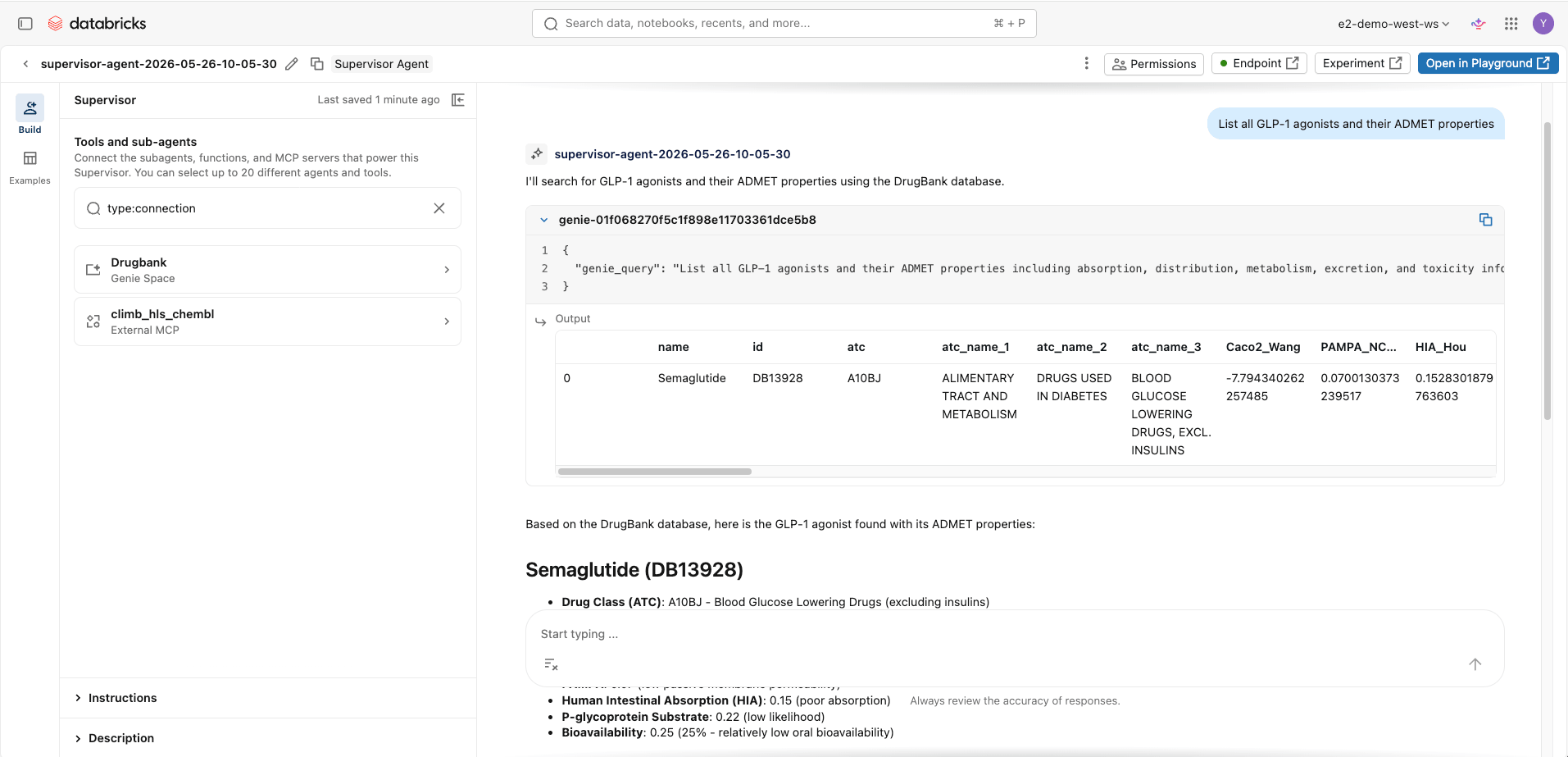
Upon deployment, Agent Bricks provides a REST endpoint automatically for easy invocation. For those needing a custom interface, you can develop one within Databricks Apps using a variety of available app templates.
Advanced (20 mins): Custom Supervisor Agent
For full customizability, you can code the supervisor agent using any agent framework (e.g. Langgraph, OpenAI Agents) in Databricks Notebooks on the cloud or a local IDE. There are multiple agent and app templates to choose from so you would hardly need to start from scratch. They even come with Agent Skills for AI coding assistants like Genie Code or Claude Code for a faster start. Additionally, these templates work with Supervisor API where you can simply define the tools.
For example, AiChemy, our drug research agent, was created using this code repository with configurable MCP servers so you can search external knowledge bases (e.g. PubChem) along with your own data (e.g. ZINC chemical library on AI Search with ECFP embeddings) for structurally similar molecules like this:
Next Steps
Whether you are just starting out or are an experienced developer, you can create your own agent using your data and MCP servers in a matter of minutes. With the growing selection of MCP servers on the Databricks Marketplace, you can quickly level up your agents.
Additionally, to accelerate your data transformation, agent development and MCP server needs, please connect with our trusted Databricks partner, Climb. Climb specializes in operationalizing enterprise AI through production-ready solutions that deliver measurable business outcomes. To learn more details about their newly launched MCP Service for healthcare and life sciences, please read more here.
For partners interested in listing their commercial MCP servers on our growing Databricks Marketplace, please review our MCP partner validation portal here.
Get the latest posts in your inbox
Subscribe to our blog and get the latest posts delivered to your inbox.