How ERGO Hestia reduced time-to-market with Databricks Lakebase and Model Serving
by Klaudia Ratkowska, Maciej Majewski, Oliver Börner and Alexander Migunov
- ERGO Hestia modernized its real-time pricing engine with Databricks Lakebase and Model Serving, bringing data, features, and decisions into one lakehouse-native platform for millisecond pricing.
- With increased scale, a multi hop architecture with an external PostgreSQL database and custom adapter layer created extraction overhead and fragmented governance across systems, slowing innovation in a regulated environment.
- ERGO Hestia now ships new pricing models to production faster, enables the pricing team to respond instantly to market conditions, and proves every decision end-to-end via Unity Catalog — turning pricing into a strategic growth engine, not an IT bottleneck.
Building the Next Generation of Real-Time Pricing
ERGO Hestia, one of Poland's leading insurance companies, operates a large-scale pricing platform supporting over 100 models and 1,000 variables. As one of Databricks' largest Polish users, ERGO Hestia has built substantial capability in state-of-the-art millisecond pricing and industry-leading execution speed.
However, because the team is constantly pursuing the next great innovation in insurance technology, they recognized an opportunity to further maximize revenue by introducing real-time B2C capabilities. While the existing architecture was highly functional, the shift toward continuous model updates and instant customer responsiveness revealed a new challenge: sustaining innovation velocity as complexity scaled. The team had mastered the art of competitive pricing and was now ready to pioneer the next generation of real-time pricing delivery.
Building on a close and productive partnership, ERGO Hestia and Databricks jointly discussed how to enhance the previous architecture for the next generation of real time pricing. This great collaboration led to the evolution of the platform using Lakebase to provide an Online Feature Store alongside Databricks Model Serving Endpoints to keep all data and logic within the Databricks ecosystem. This architecture keeps both data and model serving inside the lakehouse, eliminating external systems and reducing model deployment time By unifying governance via Unity Catalog the team integrates data and model management to ensure full traceability and long term retention of historical training sets and model versions. This architecture provides Pricing experts with a reliable audit trail to ensure every decision remains fully traceable and verifiable while maintaining peak model performance. Ultimately this transformation positions the team to accelerate innovation velocity and respond rapidly to market conditions while continuously advancing their state of the art pricing models.
The Challenge: Scaling Velocity Without Scaling Friction
The previous architecture followed a logical pattern where Databricks ingested and transformed pricing data through its medallion architecture, then exported processed datasets to an external Azure PostgreSQL database. An intermediate adapter layer handled caching and exposed data to the pricing engine. This worked well when throughput was moderate. Yet as data volume grew and model iteration accelerated, the multi-hop pattern by moving data out of the lakehouse, through an external database, through a caching layer, to the application, began to constrain performance and agility.
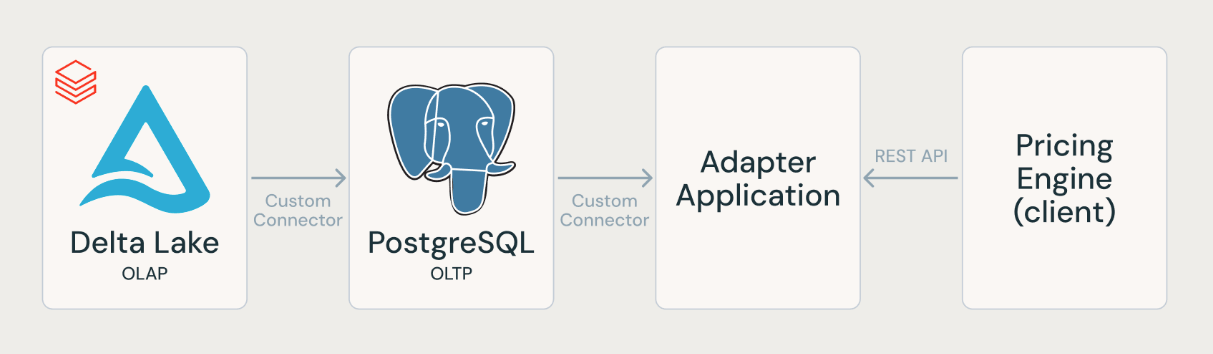
- Operational Complexity: Maintaining an external database and a custom adapter layer created significant operational overhead as the massive maintenance burden of extraction jobs emerged as the primary challenge for such critical use cases. Additionally dealing with fragmented data governance across systems including Databricks for data processing and PostgreSQL for production serving as well as custom application code to handle request logic and integration meant that lineage tracking became challenging so that compliance and auditability suffered.
- Model Deployment Velocity: The previous multi-hop architecture required careful synchronization between model logic and the underlying serving infrastructure which created a technical dependency on coordinated deployment windows. While the team already possessed the pricing expertise to iterate quickly, the complexity of the external database and adapter layer meant that updates were often scheduled for off-peak hours to ensure system stability. This specialized orchestration limited the frequency of updates during the business day to avoid performance risks in the external adapter layer.
- Data Freshness Bottleneck: Large data ingestions created performance constraints that required careful orchestration to avoid impacting operating hours. Specifically, these updates often triggered 10x to 20x latency spikes in the external serving layer, which effectively restricted data refreshes to timed batch windows. To support the strategic move toward real-time B2C pricing, the team needed an architecture that could deliver continuous data availability throughout the day without these operational trade-offs.
For an organization managing 100+ models across 1,000+ variables in a regulated industry, this fragmentation created both operational friction and governance risk.
The Solution: Consolidation within the lakehouse
ERGO Hestia's transformation was built on three core technical pillars that unified all operations within the lakehouse.
Lakebase for Unified Data Serving. Databricks Lakebase provides a relational transactional layer directly on top of Delta tables. By using Sync Tables, the team enabled continuous, automatic synchronization between processed data and the serving layer. This eliminated the need for manual orchestration and external extraction jobs. The result is a single source of truth for pricing data, living within the lakehouse.
Model Serving Endpoints for Direct API Access. Rather than routing through an intermediate application with a separate caching layer and external database the Model Serving Endpoints expose data directly to the Pricing Engine application. This eliminates the adapter layer entirely and ensures that the request logic is kept natively within Databricks. Requests flow from the pricing engine to the Model Serving Endpoints and back in milliseconds to simplify the architecture by consolidating the query execution and data serving into a single managed layer.
Model Serving for High-Velocity Ecosystem Integration. Models are first logged in MLflow and then the winning versions are registered to Unity Catalog before being exposed through dedicated Model Serving Endpoints. This architecture extends existing deployment capabilities by providing a single governed plane where pricing experts can validate models against live data in the Databricks ecosystem in real time. They can run multiple model versions simultaneously to compare performance through A/B and regression testing while the entire model lifecycle stays natively connected to the underlying data sources. This approach ensures complete visibility through built-in lineage tracking and governance controls that span both the data and the model serving layers in Unity Catalog.
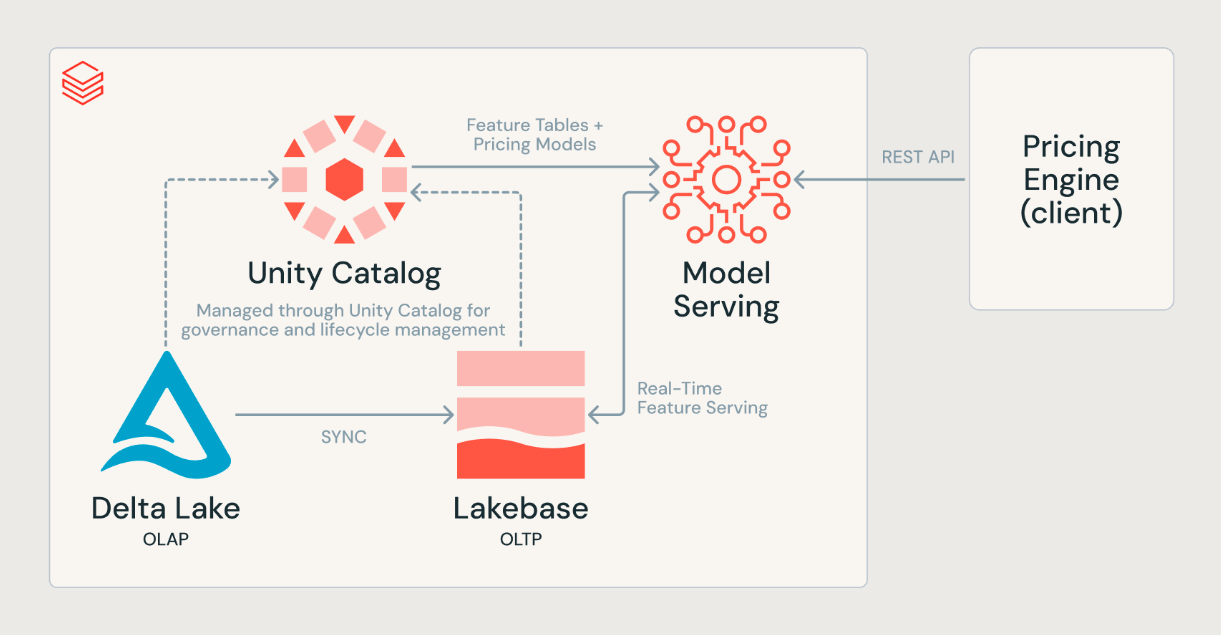
The existing ETL pipelines in Databricks required no changes and data simply synchronized to Lakebase instead of extracting to PostgreSQL. Model Serving could use existing GLM and ML models that were registered in MLflow, published to Unity Catalog, and exposed through Model Serving Endpoints. A CI/CD pipeline was utilized in Azure DevOps to orchestrate deployments.
Success through Incremental Migration: De-Risking Transformation
Rather than a coordinated cutover, ERGO Hestia adopted a staged approach that prioritized confidence and business continuity. The team began with the lowest-criticality endpoints while validating performance and stability before expanding to mission-critical systems. Pricing operations remained uninterrupted throughout.
Phase 1: Proof-of-Concept (Weeks 1–3)
The team validated the architecture with a small and well-scoped data endpoint serving a limited portfolio segment. They synchronized the existing Delta Table to Lakebase and exposed it through a Model Serving endpoint. A defining advantage of Lakebase is the unique separation of compute and storage which allowed the system to scale effortlessly to meet peak request volumes without any manual adjustments to the compute infrastructure. Databricks provided built-in observability across latency and CPU utilization as well as throughput and memory consumption. The performance tests demonstrated that the architecture far exceeded expectations with 20ms latency and less than 5% CPU utilization even under a high load of 40 requests per second. This early success eliminated architectural risk before the project expanded to production.
Phase 2: Production Deployment (Weeks 3–6)
With the PoC validated, the team began production migration starting with low-criticality endpoints. As endpoints migrated, each delivered consistent results: perfect data consistency between Delta Lake and Lakebase, stable and predictable performance, and fewer custom components required than the legacy architecture. With each successful migration, stakeholder confidence grew, enabling the team to accelerate expansion to higher-risk endpoints.
Phase 3: Traffic Splitting and Real-World Validation.
Rather than accepting a single cutover date, ERGO Hestia implemented a traffic split at production scale: half their customer base routed through legacy systems, half through the new system. This approach enabled real-world observation of actual user behavior and load patterns. The new pricing models delivered consistent quote generation and met all latency expectations. Critically, the team could validate that the new system handled production load exactly as designed.
Why This Approach Succeeded: The incremental strategy eliminated risk at each stage. Low-criticality validation prevented catastrophic system-wide failures. Successful milestones built organizational confidence and enabled faster expansion. Real-world production validation at scale confirmed the architecture worked as designed. Throughout all phases, pricing operations continued uninterrupted with zero customer impact.
Business Outcomes: Delivering Innovation Velocity
Accelerated Model Time-to-Market: Pricing experts now deploy models directly within the Databricks ecosystem where they are automatically synchronized with the latest production data. By serving models through Databricks Model Serving alongside the Lakebase Online Feature Store the team eliminates the latency typically found when syncing external model outputs with live data streams. This integration ensures that the existing agility of ERGO Hestia is now matched by a direct high-speed connection between real-time market data and the pricing engine. The ability to run these synchronized models allows for a rapid response to market conditions and competitive pricing pressure which ultimately drives higher revenue for the organization.
Operational Simplification: Operational complexity has been replaced by architectural simplicity. By removing the external PostgreSQL database and the adapter layer ERGO Hestia unified its stack under a single governance model with Unity Catalog. This move eliminated the manual overhead of patching and capacity planning while centralizing the pricing request logic within the Databricks ecosystem. With the logic and data now living together in a high performance environment the engineering capacity shifts from maintaining custom middleware to driving model innovation.
Unified Governance and Compliance: In a regulated industry, the ability to prove exactly what informed a pricing decision is critical. By unifying all pricing data and models under Unity Catalog, ERGO Hestia gains automatic audit trails, version tracking, and access controls. Data consistency is now verified automatically across the entire pipeline to ensure that the logic used in testing perfectly matches the logic in production. With the built-in platform lineage, the answer to which model served which customers during a specific period is immediate and fully auditable. This eliminates manual compliance work. Compliance teams can now prove exactly what data informed each pricing decision, who had access, and when changes occurred. Everything is automatically captured to eliminate the need for manual reconstruction while providing a foundation of trust that allows the organization to scale its revenue maximizing strategies with total confidence.
The Path Forward: Scaling Innovation across the Enterprise
The Pricing Department's success is establishing a blueprint for scaling across pricing domains. ERGO Hestia is now expanding the Lakebase and Model Serving architecture across their broader pricing organization. Each domain will consolidate its decision-making engines within the lakehouse platform, serving models and data as first-class services with unified governance.
The initial validation with a small, low-criticality endpoint proved the approach. Now the Pricing Office is scaling to larger, more critical workloads and bigger databases using the same incremental playbook. Higher-stakes datasets and complex models require more rigorous validation, but the incremental migration pattern remains unchanged.
The goal is clear: decommission the external Azure PostgreSQL database once all pricing domains have successfully migrated to Lakebase. Each domain's migration builds confidence for the next, accelerating the overall timeline toward a unified, Databricks-native pricing infrastructure.
Beyond pricing operations, consolidating all pricing data within the lakehouse unlocks new opportunities. With pricing intelligence unified in Databricks, teams can leverage AI/BI Genie to explore pricing patterns, discover insights, and answer ad-hoc business questions without requiring engineering support. The same data serving the pricing engine now powers business intelligence and AI-driven discovery, multiplying the value of the lakehouse investment.
This proven pattern now provides a template for other business functions to eliminate external dependencies and accelerate their own decision velocity.
Conclusion
ERGO Hestia's transformation illustrates a principle that applies across industries: consolidation within a unified platform accelerates innovation velocity while simplifying operations. By moving to a lakehouse-native architecture where data and models are served directly through Databricks Lakebase and Model Serving, the Pricing Department has made itself faster, more reliable, and capable of sustained innovation.
In a market defined by milliseconds, the differentiator is no longer just the model itself but the architecture that allows it to react to reality in real time. Native A/B testing, automated guardrails, and continuous audit trails in Unity Catalog ensure every decision stays traceable and within set risk boundaries.
This architecture serves as a practical reference for the wider ERGO organization and any enterprise striving to deploy millisecond pricing engines to maximize market impact and revenue growth. The question for the industry is no longer about the technical possibility of real-time pricing but about how quickly they can adopt the architecture that makes it a reality.
Get the latest posts in your inbox
Subscribe to our blog and get the latest posts delivered to your inbox.